Wednesday, June 3, 2015

Will the ECB play its trump card over Greece's future?


Will the ECB play its trump card over Greece's future?

  • 2 June 2015
  •  
  • From the sectionBusiness
Royal flush of playing cards
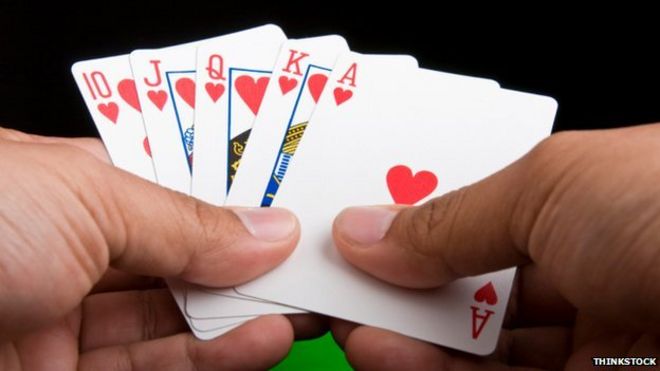
The European Central Bank has the most powerful card, the ace of trumps if you like, when it comes to dealing with the Greek crisis.
If it chose, Mario Draghi, the president of the ECB, could put Greece in a position that would leave it little choice but to start printing its own currency, and in effect leave the eurozone.
But it's not a card that he wants to play.

The ECB's trump card

As the clouds have gathered again over Greece's economic future, customers have been pulling their money out of Greek commercial banks. Private sector bank deposits in Greece declined by €23bn (£16.3bn), or 18%, between November 2014 and March this year, according to figures from the Bank of Greece.
So far, what has happened in Greece is not a full-scale run on the banks. In a previous episode of instability three years ago it was called a "bank jog". But it's at a fast enough pace to be causing concern. Because if customers take enough of their money out, and if the bank can't raise enough new funds to allow them to pay out, then banks could fail.
For now, banks are able to rely on borrowing money from the Bank of Greece (the country's central bank) using an arrangement known as emergency liquidity assistance (ELA). That is currently reported to be €80bn and has been raised repeatedly in recent months.
And this is the trump card: it's the ECB's governing council that tells the Bank of Greece whether this should continue, whether it should limit the payments or whether it should stop funding the banks.

Could they play the card?

Is there a point beyond which the ECB would call a halt to the funds channelled through the ELA?
Certainly, though it's hard to put a specific figure on it.
The key point is that ELA is supposed to be available to European banks that are solvent, but facing temporary liquidity problems.
So if the ECB's governing council took the view that the Greek banks were not solvent it would have to tell the Bank of Greece to pull the plug.

Would they?

It's a principle behind ELA and behind central bank lending in general - you don't, or should not, lend to and prop up banks that are bust. Although admittedly it is not always straightforward in practice to identify whether a struggling bank is bust or just having temporary liquidity trouble.
We know enough about what happened in the case of Cyprus to be sure that it is something the ECB would consider.
The ECB did publicly threaten to put a stop to ELA for the Cypriot banks, unless there was an international bailout that would ensure they were solvent.There was a similar threat to Ireland in correspondence which has since been published.
As for the Greek banks today, the ECB's president Mario Draghi has said they will continue to receive funding as long they remain solvent and have adequate collateral.
The view at the ECB appears to be that the banks are in temporary difficulty.Executive board member Peter Praet said in April:
"The assessment that we get is that [Greek] banks are solvent, but it is true that it is a stressful situation".
The financial troubles of the Greek state are one of the sources of that stress. There's a kind of toxic embrace between the finances of the government and the banks. The banks own Greek government debt, and some of their capital is dependent on the Greek state.
So, if the interminable political negotiations between Greece and its eurozone partners conclude with the Greek state defaulting on its debts, the country's banks will also sustain financial damage. For its part the government is ticking over - just - partly due to short term borrowing from the banks.
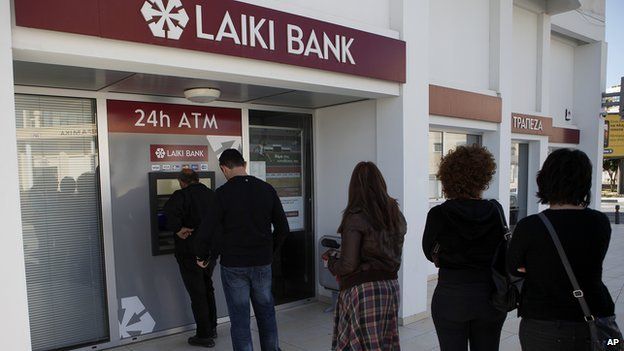
Laiki Bank, Cyprus - 2013 file pic
In early 2013 many depositors rushed to get their savings out of Cypriot banks
Another factor with a bearing on the banks' solvency is the performance of the Greek economy. The worse it gets the more loans to business and households will not be repaid.
If at any point the ECB concludes the banks are bust it could yet decide to order the Bank of Greece to turn off the taps. Arguably, it should do so in those circumstances.

What would happen then?

If the ECB pulled the plug, then Greece's banks would collapse.
The government could try to impose financial controls (as Cyprus did for a time) but the banking expert Frances Coppola doesn't think that would work. Instead,she writes, if the ELA were turned off: "Greece would have no choice but to create a completely new currency and reflate its economy directly via the central bank. That means leaving the euro, at least temporarily."
So the ECB's trump card, if it were played, could have very dramatic consequences that would be profoundly political.
It is arguable that, legally, giving up the euro is incompatible with staying in the European Union. In those circumstances, perhaps Greece would make closer friends with other powers that the EU doesn't greatly care for, such as Russia and China.
There is also the idea built into EU treaties and ideology that the euro is supposed to be for ever. A departure from that principle would have serious political ramifications and as such would constitute intervention far beyond the remit of what was envisaged for a technocratic central bank.
The ECB's main job is supposed to be stabilising prices - not redrawing the European political map. It is far from relishing the powerful hand of cards it holds.
The bank probably wishes it wasn't at the table, or better still: that there was no game underway at all.

Greek PM Tsipras set for crunch debt talks in Brussels

Greek PM Tsipras set for crunch debt talks in Brussels

  • 12 minutes ago
  •  
  • From the sectionEurope
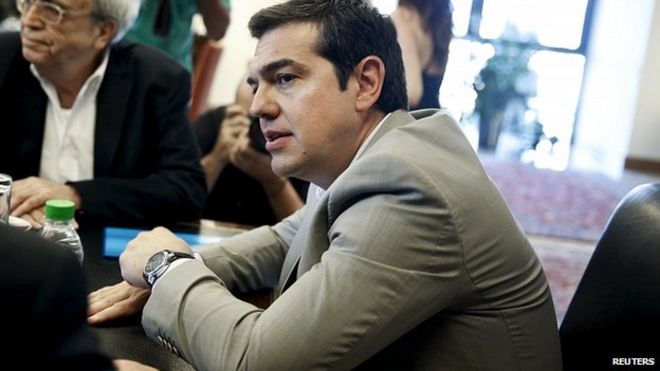
Greek Prime Minister Alexis Tsipras in meeting at Ministry of Culture in Athens. 2 June 2015
Alexis Tsipras says Greece has its own proposals to reach a deal with creditors
Greek Prime Minister Alexis Tsipras is due to take part in talks in Brussels, where he will be presented with a new plan to solve Greece's debt crisis.
International creditors will detail economic reforms needed if Greece is to receive further funding.
Mr Tsipras has already put forward new proposals of his own that he says would involve painful concessions.
A €300m (£216m) payment from cash-strapped Greece to the International Monetary Fund (IMF) is due on Friday.
The draft deal has been put together by the IMF, the European Commission and the European Central Bank following emergency talks late on Monday with German Chancellor Angela Merkel and French President Francois Hollande.
The details remain under wraps but the document is believed to call for pensions changes and an overhaul of labour laws. There are also reports of ambitious targets for Greece's primary surplus - the amount by which tax revenues exceed public spending, not including interest payments.

'Division'

Mr Tsipras will hear details of the plan when he meets European Commission President Jean-Claude Juncker and Jeroen Dijsselbloem, head of the eurozone's finance ministers, on Wednesday evening.
As he prepared to leave Athens with several key ministers, the Greek leader said he was going to meet Mr Juncker to discuss his government's proposals, and had not received any new documents from lenders.
He said he was certain Europe's leaders would "sign up to realism". "We need unity, we must avoid division," he said.

Greece in numbers

€320bn
Greece's debt mountain
€240bn
European bailout
  • €56bn Greece owes Germany
  • 177% country's debt-to-GDP ratio
  • 25% fall in GDP since 2010
  • 25% Greek unemployment rate
Reuters
Mr Juncker's spokeswoman dampened hopes of an imminent deal, telling reporters that no "final outcome" was expected from Wednesday's talks,

'Patience wearing thin'

However, in a sign that all sides are pushing for a solution, a conference call was planned between Mr Tsipras, Chancellor Merkel and President Hollande, a French official said.
The BBC's Chris Morris in Brussels says that while this deal may not quite be a take-it-or-leave-it offer, there appears to be little room for manoeuvre.
Patience is wearing thin after months of acrimonious negotiations, he says.
Mr Tsipras's far-left Syriza party won elections in January on a pledge to oppose deeply unpopular austerity measures imposed by Greece's creditors.
Breaking those promises would be a bitter pill for the Greek prime minister to swallow, our correspondent adds.
However, failure to reach a deal could trigger a Greek default and a potential exit from the eurozone.
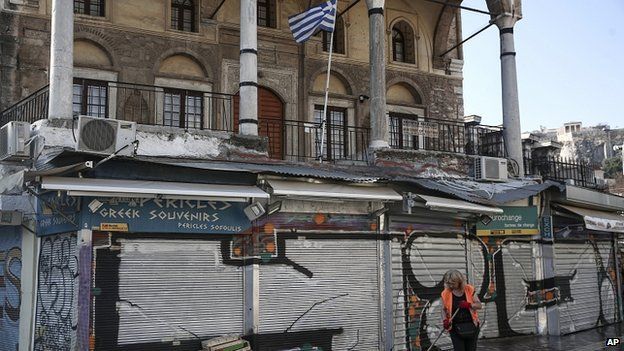
Closed shops in Athens. 31 May 2015
Greece's government is resisting cuts to salaries and pensions in return for bailouts
On Tuesday, Mr Tsipras said he had submitted "a realistic plan for Greece to exit the crisis".
He said the 47-page plan included "concessions that will be difficult", but Mr Dijsselbloem said "we are nowhere near far enough."
Syriza's parliamentary group chairman Nikos Philis warned that if "we have no prospect of a deal on Friday or Monday, we won't pay the money", referring to the 5 June debt instalment to the IMF.
Grey line

Eurozone still in denial about Greece - Robert Peston, BBC Economics editor

There is something wonderfully mad about the idea that if Greece's creditors can agree on a bailout, which they have done, that represents important progress.
Because, as won't have escaped your notice, the biggest problem all along has been that the youngish Syriza government of the debtor, Greece itself, hates the conditions imposed by the creditors for the mooted rescue.
The fundamental disagreement between Greece and its lenders - eurozone nations, the European Central Bank and the International Monetary Fund - is over the degree of further austerity to which Greece must commit in order to receive 7.2bn euros of additional credit.
But although for the pride of the creditors, the question of whether Greece is obliged to generate a surplus on its budget, excluding interest payments, of a bit more than zero or 3%, feels like a world of difference - it is a rounding error compared with the money Greece owes them, which is equivalent to 180% of Greek GDP.
Grey line
Friday's payment is the first of four totalling €1.5bn that Greece is due to pay to the IMF in June.
It is understood Greece could repay all the instalments in a single transaction at the end of the month, although it has not yet notified the IMF that it wishes to do so.
The country remains in a four-month deadlock with international creditors over the release of €7.2bn in remaining bailout funds.
In June Greece owes 6.74 billion euros
In July Greece owes 5.95 billion euros
In August Greece owes 4.38 billion euros

Tuesday, June 2, 2015

Αίγινα - Πόρος - Ύδρα κρουαζιέρα 1961

Αίγινα - Πόρος - Ύδρα κρουαζιέρα 1961

Δημοσιεύθηκε: Ενημερώθηκε: 
Μια βόλτα στην Αίγινα, την Ύδρα και τον Πόρο μας μεταφέρει η κάμερα του British Pathé.
Το βίντεο είναι γυρισμένο το 1961 και ο αφηγητής αναφέρει ότι βρισκόμαστε στην Αίγινα την ώρα που ένας αστυνομικός περπατά δίπλα σε τουρίστες που είναι έτοιμοι να ανέβουν σε κάποιο γαϊδουράκι. Στη συνέχεια βλέπουμε τους τουρίστες να ανηφορίζουν προς τον αρχαίο ναό της Αθηνάς.
Μέσα από το παράθυρο του πλοίου βλέπουμε τον Πόρο πριν μεταφερθούμε στην γραφική Ύδρα όπου και παραπλανιόμαστε στα στενά σοκάκια του όμορφου νησιού

Τεράστιες οι πολιτικές συνέπειες μιας χρεοκοπίας της Ελλάδας προειδοποιεί ο αντικαγκελάριος της Γερμανίας

Τεράστιες οι πολιτικές συνέπειες μιας χρεοκοπίας της Ελλάδας προειδοποιεί ο αντικαγκελάριος της Γερμανίας

Δημοσιεύθηκε: Ενημερώθηκε: 
D
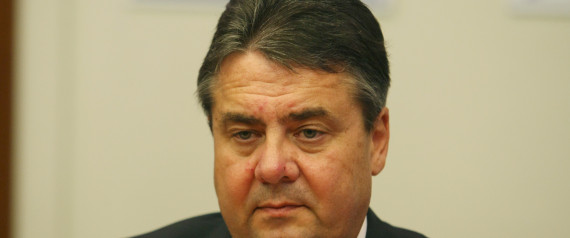
Ο αντικαγκελάριος και υπουργός Οικονομίας της Γερμανίας Ζίγκμαρ Γκάμπριελ ζήτησε από την Ελλάδα να απαντήσει στις προσπάθειες επίλυσης της κρίσης χρέους που καταβάλει η Γερμανίδα καγκελάριος Άνγκελα Μέρκελ και οι υψηλόβαθμοι συνομιλητές της.
«Θεωρώ ότι είναι απολύτως σωστό η Γερμανία και η Γαλλία να καταβάλουν ακόμη μία προσπάθεια», δήλωσε ο Γκάμπριελ, υπογραμμίζοντας ότι «οι πολιτικές συνέπειες μιας χρεοκοπίας της Ελλάδας θα ήταν φυσικά τεράστιες για την Ευρωζώνη».
«Η αλήθεια είναι ότι αν σπάσει η πρώτη πέτρα από το ευρωπαϊκό σπίτι, τότε η Ευρώπη θα συγκλονιστεί», υπογράμμισε ο Γερμανός αντικαγκελάριος.
Παράλληλα ο Γκάμπριελ χαιρέτισε το γεγονός ότι η Μέρκελ, ο Γάλλος πρόεδρος Φρανσουά Ολάντ, ο πρόεδρος της Ευρωπαϊκής Επιτροπής Ζαν-Κλοντ Γιούνκερ, η διευθύντρια του ΔΝΤ Κριστίν Λαγκάρντ και ο πρόεδρος της ΕΚΤ Μάριο Ντράγκι προσπάθησαν εκ νέου να βρουν μια λύση στην κρίση στην Ελλάδα.
(Με πληροφορίες από ΑΠΕ - ΜΠΕ)