Saturday, January 29, 2011

Πολιτική | 28.01.2011

Θα τα καταφέρει ο Ελ Μπαραντέι στην Αίγυπτο;


Για "αστυνομική βία και πρωτοφανή ανυπακοή" κάνουν λόγο τα πρακτορεία στις σημερινές κινητοποιήσεις στην Αίγυπτο. Ο Ελ Μπαραντέι, που επιδιώκει να ηγηθεί της αντιπολίτευσης, φαίνεται ότι βρίσκεται υπό περιορισμό.

 
Περισσότερο από όλα του αρέσει να βρίσκεται στη Βιέννη, είχε δηλώσει ο Μοχάμετ Ελ Μπαραντέι λίγο μετά που αποχώρησε από τη θέση του ως πρώην επικεφαλής της Διεθνούς Υπηρεσίας Ατομικής Ενέργειας.
Κατά τη διάρκεια της θητείας του έδειξε θάρρος και αντιπαρατέθηκε με τον Αμερικανό πρόεδρο Τζωρτζ Μπους για Ιράκ και τα όπλα μαζικής καταστροφής. Γρήγορα κατάλαβε ωστόσο ότι έχει περιορισμένες δυνατότητες κινήσεων και επιρροής. Κάτι που διαπίστωσε σαφέστατα στη διένεξη με το Ιράν και το πυρηνικό του πρόγραμμα, αλλά και με τη Βόρεια Κορέα.

Μεγάλες προσδοκίες....Μεγάλες προσδοκίες....Ο Μοχάμετ Ελ Μπαραντέι διηύθυνε τη Διεθνή Υπηρεσία Ατομικής Ενέργειας από το 1997 μέχρι το 2009. Πριν από έξι χρόνια του απονεμήθηκε το Νομπέλ Ειρήνης. Κατά την απονομή είχε δηλώσει:

«Το Νομπέλ αυτό μας θυμίζει τους μεγάλους κινδύνους της εποχής μας: Όπως τη συνεχιζόμενη διάδοση των πυρηνικών όπλων, την ύπαρξη χιλιάδων πυρηνικών βομβών, αλλά και τον κίνδυνο να πέσουν τα πυρηνικά όπλα στα χέρια τρομοκρατών».

Έχει φίλους παντού στον κόσμο

Ο Ελ Μπαραντέι θεωρούνταν "φίλος της Μέσης Ανατολής", άνθρωπος που κινεί τα νήματα και που δεν μασάει τα λόγια του. Προειδοποίησε τις ΗΠΑ και το Ισραήλ για τις συνέπειες που θα είχε ένα πιθανό χτύπημα εναντίον του Ιράν.
Τότε είχε δηλώσει ότι σε περίπτωση που η κατάσταση εξελισσόταν σε στρατιωτική αντιπαράθεση, θα εγκατέλειπε το αξίωμά του. Δεν ήθελε να κατέχει αυτό το αξίωμα με οποιοδήποτε τίμημα.

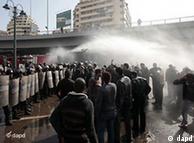
Σκληρή η αστυνομία απέναντι στους διαδηλωτέςΣκληρή η αστυνομία απέναντι στους διαδηλωτέςΟ Αιγύπτιος αξιωματούχος δέχθηκε όμως και έντονη κριτική, όπως για παράδειγμα ότι υπερεκτίμησε το ρόλο του, μετά την απονομή του Νομπέλ Ειρήνης. Οι Αμερικανοί του επέρριπταν ότι στήριζε κατά κάποιο τρόπο το Ιράν και καταδίκαζε το Συμβούλιο Ασφαλείας των ΗΕ σε απραξία. Παρόλα αυτά ο Ελ Μπαραντέι είχε φίλους σε ολόκληρο τον κόσμο και πίστευε στη διεθνή συνεργασία:

«Οι κίνδυνοι μπορούν να αντιμετωπιστούν μόνο με τη διεθνή συνεργασία. Αυτή είναι σήμερα η μεγάλη πρόκληση», υποστήριζε.

Ο Ελ Μπαραντέι θεωρούσε πως το αξίωμα του ήταν πολιτικό. Δεν έβλεπε τον εαυτό του ποτέ σαν τεχνοκράτη. Επίσης δεν έκανε πάντα αυτό που περίμεναν οι άλλοι από αυτόν. Ενδέχεται η  τακτική αυτή να μην βοήθησε πολύ την υπηρεσία του, τον ίδιο πάντως δεν τον έβλαψε.


Andreas Meyer Feist / Μαρία Ρηγούτσου

Υπεύθ. σύνταξης: Βιβή Παπαναγιώτου
 dw

Friday, January 28, 2011

Τροπολογία ΝΔ για το Άσυλο

Τροπολογία ΝΔ για το Άσυλο

Συντηρητικός καθωσπρεπισμός, ενοχικής κυβέρνησης : ΣΚΑΪ - www.skai.gr

Συντηρητικός καθωσπρεπισμός, ενοχικής κυβέρνησης : ΣΚΑΪ - www.skai.gr

As Clashes Continue, Why Fear of Islamists Paralyzes the U.S. on Egypt

Click here to find out more!
An Egyptian protester flashes Egypt's flag as anti-riot policemen use water canon against protesters in Cairo, Egypt, Friday, Jan. 28, 2011
Lefteris Pitarakis / AP
The language coming out of the Obama Administration as Egypt lurched into another political showdown in the streets on Friday — the latest demonstration saw thousands of anti-government protesters clash with police in Cairo, who fired rubber bullets into the crowds and used tear gas and water cannons on them — has verged on the bizarre. President Hosni Mubarak is hailed by Secretary of State Hillary Clinton and her spokesman, P.J. Crowley, as an "anchor of stability" providing vital assistance to U.S. regional goals, yet the protests demanding his ouster are soothingly described as "an opportunity" for the regime to demonstrate that it is able to respond to the demands of its citizenry by means other than guns, batons and prison cells.
"Our assessment is that the Egyptian government is stable and is looking for ways to respond to the legitimate needs and interests of the Egyptian people," Secretary Clinton said earlier this week, adding that the government "has an important opportunity at this moment in time to implement political, economic and social reforms." She urged the regime to refrain from blocking peaceful protest or shutting off communications networks — pleas that appear to have been ignored going into Friday as the government shut down Internet and SMS communication and arrested activists ahead of the demonstrations planned for after Friday prayers. It's been reported by the AP that the police also used water cannons against Egypt's pro-democracy leader Mohamed ElBaradei and his supporters. The wire service wrote that a soaking wet ElBaradei was trapped inside a mosque nearly an hour after him and his supporters were water cannoned. Hundreds of riot police laid siege to the mosque, firing tear gas in the streets surrounding it so no one could leave. The tear gas canisters set several cars ablaze outside the mosque. Several people fainted and suffered burns.(See pictures of Egypt's protests.)
Mubarak may be listening more closely than Clinton is to what the protesters are saying: first and foremost among their "legitimate needs," by their own definition, is for Mubarak to step aside — a cause they have no place to press other than in the streets, since the regime has repeatedly rigged elections to keep Mubarak in power. He may be Washington's most important friend among Arab leaders, but those who will brave the wrath of his security forces in Egypt's streets on Friday believe he is a tyrant whose time is up.
Clinton's urging of Mubarak to make reforms and refrain from the temptation to simply crack down reflects lessons learned by the U.S. from the fall of other friendly autocrats, from the Shah of Iran in 1979 to Tunisia's Zine el Abidine Ben Ali earlier this month. Those governments failed to recognize the depth of popular anger and make sufficient political and economic concessions to defuse it. The Obama Administration is simply urging Mubarak to do what is necessary to preserve his regime — while recognizing that the order to fire on unarmed fellow citizens can provoke a crisis in the security forces that can bring down the regime.(Will ElBaradei run for president of Egypt?)
Reform is not necessarily the same as democracy, however, and after 30 years under the same President, those who are taking to the streets want regime change rather than the kindlier, gentler Mubarak the U.S. would appear to prefer. The Obama Administration's dilemma over how to respond to Egypt's democracy movement became a little more acute on Thursday when the country's largest opposition party, the banned Muslim Brotherhood, declared its intention to openly participate in Friday's protests. Years of operating in conditions of twilight legality have given the Brotherhood an unrivaled organizational network — its members expect to be arrested and roughed up by the regime — and it is widely viewed as by far the most popular party in the opposition. That's a problem for the U.S., given its singular allergy to Islamist parties in the Arab world, particularly those that challenge its longtime allies.
Democracy movements are attractive to Washington when they target a regime such as Iran's, but in allied autocracies, they're a problem. There's no way for Egypt to be democratic and exclude the Islamists from political participation. The same is true for most other parts of the Arab world — a lesson the U.S. ought to have learned in Iraq, where Islamists have dominated all the democratically elected governments that followed Saddam Hussein's ouster. But when the Islamists of Hamas won the last Palestinian elections in 2006, held under pressure from Washington, the Bush Administration literally did a 180-degree turn on the question of Palestinian democracy. Meanwhile, much of the commentary on Ben Ali's ouster in Tunisia has hailed the apparent absence of Islamists from the protest movement, but that may be premature. After the repression they suffered under the dictatorship, Tunisia's Islamists have yet to emerge, as does the character of a new regime. Islamists may not dominate or even seek to, but don't bet against them becoming an integral part of Tunisian democracy.(Is Egypt about to have a Facebook revolution?)
There are many different models of Islamist politics competing with U.S. allies and with each other for support in the Middle East, ranging from the violent extremism of al-Qaeda to the modernizing, business-friendly democrats of Turkey's ruling AK Party. But they tend to share a hostility toward U.S. intervention in the region, and toward Israel.
Explaining why the U.S. continues to support Mubarak, the State Department's Crowley on Thursday told al-Jazeera that "Egypt is an anchor of stability in the Middle East ... It's made its own peace with Israel and is pursuing normal relations with Israel. We think that's important; we think that's a model that the region should adopt."
The problem for Washington is that Arab electorates are unlikely to agree. The democratically elected Iraqi government, for example, despite its dependence on U.S. support, has stated its refusal to normalize relations with Israel. A democratic Egypt, whether led by the Muslim Brotherhood or any other opposition party, is unlikely to go to war with Israel given the vast imbalance in military capability, but they're even less likely to accept normal ties given the present condition of the Palestinians. And the most secular liberal activists in Egypt reject with contempt the argument that regional stability can come at the expense of their right to choose their government.
Turkey, once its electorate was given a voice in matters of state, denied the U.S. the right to use its territory to invade Iraq. It has become more assertive in challenging both Israel and the U.S. strategy on Iran. Arab electorates are unlikely to give Washington the sort of support against Iran it gets from the region's pro-U.S. autocrats.(See video of Egypt's protests explained.)
The problem the Administration now confronts is that backing autocrats who support U.S. regional policy is no longer simply uncomfortable given the values Washington professes to uphold: it's increasingly untenable as the forces of demographics, economics and technology gnaw at the bonds imposed by those autocrats. The Egyptians, young and old, that risk life and limb by taking to the streets on Friday may not have the patience for the pace and nature of change envisaged by Secretary Clinton.


Read more: http://www.time.com/time/world/article/0,8599,2044902,00.html#ixzz1CKyOObUv

MIDDLE EAST | 28.01.2011

ElBaradei strengthens his tone as Egypt's regime clamps down harder


As mass protests get underway, dissident opposition figure Mohamed ElBaradei strengthened his tone against the Mubarak regime. Analysts wonder if ElBaradei's rallying calls can bring the fractured opposition together.

 
Mass protests are underway in Egypt following traditional Friday prayers. Tens of thousands of demonstrators are defying a government ban and gathering in Cairo. Eyewitnesses said police used water canons and fired warning shots to disperse the protesters.

The opposition groups calling for President Hosni Mubarak to stand down were expected to be joined by Mohamed ElBaradei, the dissident opposition figure, who returned to Cairo on Thursday.

But reports from Arab broadcaster Al-Jazeera suggested that ElBaradei had been detained at a mosque in Cairo and was being prevented from joining the protests by security forces.

Earlier Friday, ElBaradei spoke to the British Guardian newspaper, striking his hardest tone yet since flying into the country from Vienna on the previous evening.
"I'm sending a message to the world that Egypt is being isolated by a regime on its last legs," he told the Guardian.
"There is of course a risk to my safety today, but it's a risk worth taking when you see your country in such a state you have to take risks," he added. "I will be with the people today."
As the Mubarak regime cracked down on mobile phone and Internet services, effectively cutting the lines of communication between the opposition groups and isolating Egypt off from the rest of the world, ElBaradei called on the international community to take action.
"Egypt today is in a pre-information age," he said. "The Egyptians are in solitary confinement – that's how unstable and uncomfortable the regime is. Being able to communicate is the first of our human rights and it's being taken away from us. I haven't seen this in any other country before."
"The international community must understand we are being denied every human right day by day," he said. "Egypt today is one big prison. If the international community does not speak out it will have a lot of implications. We are fighting for universal values here. If the west is not going to speak out now, then when?"
His statements were much harsher than those he maqde on his return when ElBaradei, a Nobel Peace Prize winner and former head of the International Atomic Energy Agency, indicated that he would help head a transitional government should the current regime fall.
"If people, in particularly young people, if they want me to lead the transition I will not let them down. My priority right now is to see a new Egypt and to see a new Egypt through peaceful transition," he said on his arrival in Cairo. "I am still here hoping to continue to manage the process of change in an orderly way, in a peaceful way. I hope the regime will do the same."

"I hope the regime will stop violence, stop detaining, stop torturing people."

Protest groups look to ElBaradei for focus and leadership

Some observers are unsurprised by the growing clamor for ElBaradei to lead the disparate opposition factions, give them focus and help channel the frustrations of the Egyptian people into positive political change.

"The opposition has been weak and stagnant for so long that it is no surprise that they are rallying behind ElBaradei," Dr. Amr Hamzawy, research director at the Carnegie Middle East Centre in Beirut, told Deutsche Welle. "They have very little representation in parliament, their work and ability to reach out effectively to constituencies has been heavily restricted since the state of emergency came into power in 1981 and they have failed to convince Egyptians that they have a solid platform and policies."
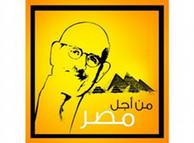
poster of elbaradei campain in EgyptCampaigns of support for ElBaradei are growing in Egypt"The opposition is splintered along an ideological divide, between Islamists and secularists and its potential power has been stripped by constant in-fighting. Those who are in a position of relative power are there because they have struck a deal with the government; they agree to limit their reach in return for a guaranteed percentage of seats."

Kristian Ulrichsen, a Middle East expert at the London School of Economics and Political Science says that ElBaradei fits into the picture and could provide a focal point. "As a high-profile and internationally well-known opponent of the regime he could provide the figurehead with the domestic legitimacy that the Tunisian opposition lacked in comparison."

However, ElBaradei's arrival and pledges of support will not necessarily solve all the problems facing the opposition as they look to ouster the Mubarak regime. Indeed, his return could generate a whole new set of issues to contend with.

Critics of returning dissident refuse to accept him

The Muslim Brotherhood, Egypt's largest opposition group, has continually rejected the idea of supporting ElBaradei's potential appointment as a unifying opposition leader. "Those who support ElBaradei are an elitist bloc with no roots in the Egyptian street," senior Brotherhood leader Mohammed Habib has been quoted in local media as saying.

The Brotherhood, whose members have so far participated individually in the protests, announced Thursday that it would collectively join the demonstrations on Friday.

"El Baradei's ability to project himself as a figurehead might be constrained by his narrow base of political support in Egypt’s middle classes," Ulrichsen said. "He will need to expand this if he is to become a viable leader in waiting, and in particular will need to reach out to the Muslim Brotherhood to secure their tacit acquiescence, at the very least."

Leadership accession will only be the start
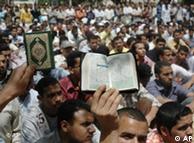
Muslim Brotherhood students hold a copy of the Quran during a protest at the al-Azhar university The Muslim Brotherhood rejects ElBaradei as an elitistShould ElBaradei succeed in uniting the opposition forces and lead a peaceful transition government if and when Mubarak stands down, the initial galvanising effect his leadership might have would make way for increased pressure to tackle Egypt's social and economic problems.

Analysts believe it will take more than just a change of leadership to successfully implement the structural challenges needed in Egypt's faltering political economy.

"Pressures for political reform and liberalisation may also expose a rift between demands for democratic change on the one hand, and for greater religiosity in public life on the other," Ulrichsen said. "The attitude of the United States as a major security and donor partner will also be important, and ElBaradei will need to balance their interest in a stable Egypt with the more transformative aspirations of the popular protests which have risen in recent weeks."

Author: Nick Amies
Editor: Rob Mudge
 dw
aravella_orkizetai.jpg
 
OΡΚΟΜΩΣΙΑ ΑΡΑΒΕΛΑΣ ΣΙΜΩΤΑ ΣΤΗΝ ΝΕΑ ΥΟΡΚΗ                     FROM kefalonia press

Thursday, January 27, 2011

HOLOCAUST | 27.01.2011

German President makes historic speech at Auschwitz


President Christian Wulff called on Germans to prevent an event like the Holocaust from ever happening again at ceremonies marking Holocaust Remembrance Day. He spoke at Auschwitz, a first for a German head of state.

 
German President Christian Wulff marked Holocaust Remembrance Day on Thursday with a historic speech at Auschwitz, the site of the largest Nazi death camp during World War II.

"We all carry responsibility that such a breach of civilization does not happen again," he said.

Wulff was the first German president ever to speak at the Auschwitz commemoration. He also met camp survivors with Polish President Bronislaw Komorowski.

"Since World War II, across the globe there has not been a single day without war," Wulff said. "This is an appeal to youth to take responsibility for what is happening. Indifference is the worst threat to democracy and liberty."

January 27 marks the day when Soviet troops liberated Auschwitz-Birkenau in 1945. Around 1.5 million people were murdered there, the vast majority of them European Jews.

The anniversary was declared an international day of remembrance for the six million victims of the Holocaust by a 2005 UN General Assembly resolution. Germany has marked the day since 1996.Watch tower and camp at AuschwitzAbout 1.5 million people were killed at Auschwitz in Poland

Roma Holocaust survivor speaks

Official ceremonies took place across Germany. Roma Holocaust survivor Zoni Weisz addressed the country's parliament in Berlin. The speech symbolized an effort by Germany to give more recognition to the non-Jewish victims of the Holocaust.

Weisz, 73, told the Bundestag that Sinti and Roma probably represent the most persecuted ethnic minority in Europe today, and that their genocide during Nazi Germany was a "forgotten Holocaust."

"Society has learned little to nothing from this, but rather it has dodged its responsibility to us," he said. "The vast majority [of Roma] have no opportunity, no work, no education and live without regular medical care."

Historians estimate that between 220,000 and 500,000 Roma and Sinti, otherwise known as gypsies, were killed by the Nazis, out of a total population of around one million in Europe before World War II. They were also systematically persecuted, confined to ghettos, deported and subjected to grotesque medical experiments.

Since then, their population has swelled to around 12 million in Europe. Tens of thousands live in Germany, many of them refugees from Bosnia and Kosovo.

West Germany did not officially recognize the genocide of Roma and Sinti until 1982.Roma woman with childrenWeisz said Roma and Sinti are the most persecuted minority in Europe today

New focus for memorial day

Weisz was born in Holland to an instrument maker and grew up in the eastern town of Zutphen. His family was deported to the east in 1944 when he was 7, but he survived thanks to a policeman who helped him escape.

Weisz lived out the rest of the war in hiding, but his parents, sisters and younger brother were all murdered in Auschwitz. He said he was "surprised and honored" when asked to speak to the Bundestag.Topf und Söhne factory siteThe Topf & Söhne factory in Erfurt is to become a Holocaust memorial site

"It is the first time that the fate of the Sinti and Roma of Europe has been placed at the center of the commemorations - finally," said the head of the Council of Sinti and Roma in Germany, Romani Rose.

There was also a special commemoration at the eastern German city of Erfurt, where the Topf & Söhne engineering plant, which manufactured crematoria for Nazi death camps, is to be turned into a Holocaust memorial site.

"The factory was not a place were people were murdered or tortured, but it was a place where engineers calculated how dead bodies could be burned as quickly and effectively as possible," said the exhibition's leader, Annegret Schüle.

Later this year, Germany will inaugurate a national memorial to Sinti and Roma murdered by the Nazis.

Authors: Andrew Bowen, Shant Shahrigian (epd, dapd, dpa)
Editor: Nicole Goebel
 dw