Saturday, January 28, 2012


Πολιτική | 28.01.2012

Η Ελλάδα θα παραμείνει στην ευρωζώνη εκτιμά η Ά. Μέρκελ


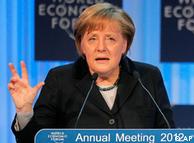
Υπέρ της παραμονής της Ελλάδας στην ευρωζώνη τάσσεται η γερμανίδα καγκελάριος Μέρκελ, προβαίνοντας στην εκτίμηση ότι η Αθήνα δεν θα εγκαταλείψει το κοινό νόμισμα

 
Σε συνέντευξή της προς την Bild am Sonntag που κυκλοφορεί αύριο η Άγκελα Μέρκελ επαναλαμβάνει την άποψη ότι η Ελλάδα θα πρέπει να διατηρήσει το ευρώ και προσθέτει πως η ευρωζώνη έχει 17 μέλη, τα οποία αναμένει, να γίνουν περισσότερα. Στην ίδια συνέντευξη η καγκελάριος υπογραμμίζει τον σημαντικό ρόλο του ευρώ για την ευρωπαϊκή ολοκλήρωση και χαρακτηρίζει το κοινό νόμισμα καθοριστικό βήμα για την ένωση της Ευρώπης, το οποίο δεν μπορεί να ακυρωθεί χωρίς μεγάλους κινδύνους και αρνητικά επακόλουθα. Ιδίως η Γερμανία ωφελήθηκε πολύ από το ευρώ, παρατηρεί η καγκελάριος.
Λαγκάρντ: Θα υπάρξει ανάπτυξη σε κάποιες χώρες της ευρωζώνης
Βλέπει περιθώρια ανάπτυξης η Κριστίν Λαγκάρντ Βλέπει περιθώρια ανάπτυξης η Κριστίν ΛαγκάρντΑντίθετα, ο πρόεδρος της Χριστιαμοκοινωνικής Ένωης (CSU) και πρωθυπουργός της Βαυαρίας, Χορστ Ζεεχόφερ δεν αποκλείει το ενδεχόμενο να εγκαταλείψει η Ελλάδα την ευρωζώνη. «Θα πρέπει να αντιμετωπίσουμε αυτή τη συζήτηση», δήλωσε χαρακτηριστικά στην εφημερίδα Rheinische Post του Ντίσελντορφ ο κυβερνητικός εταίρος της καγκελαρίου.
Η επικεφαλής του ΔΝΤ Κριστίν Λαγκάρντ διακρίνει τη δυνατότητα αύξησης της ανάπτυξης σε κάποιες χώρες της ευρωζώνης. Αυτό θα ενίσχυε την οικονομία συνολικά της ευρωζώνης, τόνισε στο Νταβός η κα Λαγκάρντ, καλώντας παράλληλα τις 17 χώρες του κοινού νομίσματος να οικοδομήσουν ένα ισχυρό τείχος προστασίας προκειμένου να μην επιτρέψουν τη μετάδοση της κρίσης χρέους. Το ΔΝΤ, πρόσθεσε μπορεί να βοηθήσει στην αντιμετώπιση της κρίσης, αλλά χρειάζεται περισσότερους πόρους.
Σταμάτης Ασημένιος, afp
Υπεύθ. Σύνταξης: Σπύρος Μοσκόβου
 
 
dw

Πολιτική | 24.01.2012

Όχι περικοπές μέχρι τελικής πτώσης!


Η Ελλάδα και οι υπόλοιπες υπερχρεωμένες χώρες της Ευρωζώνης δεν θα πρέπει να υποστούν περικοπές μέχρι τελικής πτώσης, δηλώνει ο Γερμανός καθηγητής Πέτερ Μπόφινγκερ στον ραδιοσταθμό Deutschlandfunk.

 
Ο Πέτερ Μπόφινγκερ είναι ένας εκ των «πέντε σοφών» της γερμανική οικονομίας, οι οποίοι συμβουλεύουν και την καγκελάριο Άνγκελα Μέρκελ. Για την Ελλάδα εκτιμά ότι είναι χαρακτηριστικό παράδειγμα αποτυχημένης στρατηγικής εκ μέρους της Ευρωζώνης και θύμα υπερβολικών περικοπών.
«Η Ελλάδα είναι ένα πολύ καθαρό παράδειγμα για το πόσο επικίνδυνη μπορεί να είναι αυτή η στρατηγική: να προσπαθεί κανείς με όλο και περισσότερες περικοπές να τηρήσει τους στόχους για το έλλειμμα σε μία περίοδο που η οικονομία βρίσκεται σε ύφεση. Νομίζω ότι πρέπει να το έχουμε στο μυαλό μας αυτό το παράδειγμα για να αποφύγουμε παρόμοιες αρνητικές συνέπειες στην Πορτογαλία, την Ιρλανδία, την Ισπανία ή την Ιταλία» υποστηρίζει ο Γερμανός οικονομολόγος.
«Επικίνδυνος δρόμος για την Ελλάδα»
Λάθος συνταγή για την Ελλάδα;Λάθος συνταγή για την Ελλάδα;Αν και ο καθηγητής Μπόφινγκερ εκ της θέσεώς του θεωρείται άτυπος σύμβουλος της γερμανικής κυβέρνησης, ωστόσο ασκεί έντονη κριτική στους χειρισμούς της καγκελαρίου και του υπουργού Οικονομικών. Κατά την άποψή του μάλιστα, η Άνγκελα Μέρκελ και ο Βόλφγκανγκ Σόϊμπλε ακολουθούν έναν «επικίνδυνο δρόμο»:
«Το μεγαλύτερο ρίσκο για την Ευρωζώνη είναι η είσοδος σε έναν αρνητικό κύκλο ύφεσης και στραγγαλισμού της οικονομικής ανάπτυξης. Το βλέπουμε ήδη με τις προγνώσεις για την Ιταλία και την Ισπανία που αναθεωρούνται συνεχώς προς τα κάτω. Και στις δύο χώρες αναμένουμε αρνητικό δείκτη ανάπτυξης -2% και αν αυτή η τάση παγιωθεί, τότε θα είναι αδύνατον να σταθεροποιήσουμε το χρέος, θα προστεθούν νέα ελλείμματα και η αβεβαιότητα στις αγορές θα επιδεινωθεί. Το κύριο πρόβλημά μας είναι λοιπόν να αποφύγουμε αυτόν τον αρνητικό κύκλο στην Ευρωζώνη. Αυτό ακριβώς το ζήτημα έθεσε με σαφήνεια και η κ.Λαγκάρντ» τονίζει ο καθηγητής Μπόφινγκερ.
Η επικεφαλής του Διεθνούς Νομισματικού Ταμείου προειδοποιεί ότι αν η Ευρωζώνη παραμείνει απαθής θα οδηγηθεί σε μεγάλη ύφεση, παρόμοια με εκείνη στη δεκαετία του ’30 και χρησιμοποιεί ακόμη και αποφθέγματα του Γκέτε για να πείσει την Γερμανίδα καγκελάριο.
Οι αντιφάσεις του ευρωπαϊκού μηχανισμού στήριξης
Αντιδράσεις προκαλεί η πρόταση Μόντι για διπλασιασμό κεφαλαίων του μηχανισμού στήριξης.Αντιδράσεις προκαλεί η πρόταση Μόντι για διπλασιασμό κεφαλαίων του μηχανισμού στήριξης.Διαμφισβητούμενη παραμένει και η πρόταση για ενίσχυση κεφαλαίων του σημερινού Ευρωπαϊκού Μηχανισμού Στήριξης, την οποία φαινεται να υποστηρίζει η Κριστίν Λαγκάρντ. Ο καθηγητής  Μπόφινγκερ πάντως υποστηρίζει ότι πρόκειται για προσωρινή λύση που ενέχει πολλές αβεβαιότητες και αντιφάσεις: «Το πρόβλημα με αυτούς τους μηχανισμούς στήριξης είναι ότι προβλέπονται ως λύση ανάγκης και επομένως θεωρείται στίγμα για μία οικονομία να έχει προσφύγει σε αυτούς. Γι αυτό, χώρες όπως η Ιταλία και η Ισπανία διστάζουν να καταφύγουν στον μηχανισμό και θα το κάνουν, εάν χρειαστεί να το κάνουν, μόνο σε έκτακτη και μεγάλη ανάγκη. Αυτό πάλι δεν θεωρείται ιδανική λύση, γιατί το νόημα της στήριξης θα ήταν ακριβώς να αποτρέψουμε περιπτώσεις έκτακτης ανάγκης».
Κανόνες γενικής και απόλυτης εφαρμογής δεν υπάρχουν. Γι αυτό ο καθηγητής Μπόφινγκερ διατηρεί επιφυλάξεις για το επερχόμενο σύμφωνο δημοσιονομικής πειθαρχίας. «Είναι αξιέπαινη η προσπάθεια να διακανονιστούν όλες οι πτυχές της δημοσιονομικής πολιτικής εκ των προτέρων, αλλά η εμπειρία της κρίσης μας δείχνει ότι είναι δύσκολο να προβλέψουμε τις εξελίξεις, ότι πάντα θα ανακύπτουν καταστάσεις στις οποίες οι κανόνες μας δεν εφαρμόζονται και όπου πάντα θα πρέπει να κινηθούμε εκτός πλαισίου για να θέσουμε τα πράγματα υπό έλεγχο. Επομένως δεν περιμένω και πολλά από αυτούς τους κανόνες» επισημαίνει ο καθηγητής Μπόφινγκερ.
Dirk Müller / Γιάννης Παπαδημητρίου
Υπεύθυνος Σύνταξης: Στέφανος Γεωργακόπουλος   dw

RUSSIA | 28.01.2012

Working-class rally shows support for Putin


While many middle-class Russians took to the streets in anti-Kremlin protests following elections last month, members of the working class have now begun to organize their own rallies in support of Vladimir Putin.

 
Thousands of supporters of Russian Prime Minister Vladimir Putin rallied in the city of Yekaterinburg on Saturday to back his bid to return to the Kremlin as president.
Police told Reuters that around 10,000 people gathered at the demonstration, which was organized by labor groups to show that many in Russia's working class still support Putin.
While Putin was not in attendance, many of the attendees of the rally were bused into the city for the event.
"Buses were laid on for us at the factory," Andrei Mandure, a worker at a chemical plant in the town of Lesnoy, said.
Opposition presence
Large anti-Putin rallies held in Moscow following legislative elections on December 4 were mostly attended by middle-class Russians. The protests were against what many perceived as widespread fraud perpetrated by the ruling United Russia party, which won only a narrow majority in the lower house of parliament, the Duma.
The Interfax news agency quoted regional police spokesman Valery Gorelykh as saying Saturday's "meeting had proceeded calmly without any violations of the public order."
Workers from the Uralvagonzavod factory in Yekaterinburg organized the rally, which took place near the central train station, making it easy to transport in other workers from nearby regions.
The Russian Trade Union Federation, which represents some 25 million workers, is planning pro-Putin rallies across Russia ahead of the presidential election on March 4.
Author: Andrew Bowen (AFP, Reuters)
Editor: Stuart Tiffen
 
 
dw

GREECE | 17.01.2012

Greece faces deep structural reform as options run out


The EU, European Central Bank and the International Monetary Fund are due in Athens to check Greece's progress on structural reforms. Financial experts want to see big changes in the labor market.

 
Technical teams representing the European Union, the European Central Bank (ECB) and the International Monetary Fund (IMF) arrived in Athens on Tuesday to prepare for talks on a second bailout for Greece, as the country comes under greater pressure to reduce its deficit and revive its economy.
Greece has managed to reduce its 2011 budget deficit to 9.6 percent of its gross domestic product (GDP). According to Greek Economics Minister Michalis Chryssochoidis, that's below the psychologically important 10 percent mark.
Reducing the budget deficit to below 10 percent can be seen as a success given all the doom and gloom surrounding Greece's debt crisis. But that 9.6 percent is at least half a percentage point off the mark from the deficit goal for 2011.
As a consequence, Greece has to find a way to save an additional 1.5 billion euros ($1.9 billion), which may give the so-called troika cause to take issue with the Greek government. The mission heads of the EU, the European Central Bank and the IMF are expected to arrive in Athens on Friday.
Yet even the troika has come to the conclusion that no more money can be squeezed out of retirees and small earners. Instead, financial experts are pushing for reform in the labor market in order to reduce costs and stimulate the competitiveness of the Greek economy.
Labor market reform
For the first time, the statutory minimum wage and guaranteed Christmas and vacation pay are on the table, according to Jannis Lixouriotis, a lawyer and professor of labor law at the University of Athens. But Lixouriotis said he does not believe that these measures go far enough, given the current state of the Greek economy.
"The freezing of wages and reduction of Christmas money alone are not enough. Instead it's much more important that the bargaining powers sit at the same table and negotiate deep structural reforms in the labor market," Lixouriotis told Deutsche Welle.Greek riot police deployed at protestAusterity has caused social unrest in Greece
Lixouriotis said that a single agreement cannot dictate the level of all salaries and wages in the country, as is currently the case, without taking the productivity of individual economic sectors into consideration. More flexibility is necessary, he said.
Many people would lose their jobs today simply because their employer is not authorized to give them new assignments or relocate them elsewhere, a state of affairs that Lixouriotis argued cannot continue.
Troika scapegoat
Just a few hours after the troika's expected arrival in Athens, employees and employers plan to meet for talks. But the unions have rejected wage cuts and said they are only willing to negotiate over the reduction of indirect labor costs. The Greek government, led by the former central banker Lucas Papademos, has said it would declare a wage freeze if the bargaining powers cannot come to an agreement. 
In addition, government spokesman Pantelis Kapsis threatened further cuts when he explained that Greece's minimum wage is much higher than that of Spain.
"The government uses the troika as an alibi for its own inaction," Lixouriotis said, adding that he believes that Greece's problem is above all a Greek problem, not a European one, as it is often portrayed. The politicians, however, refuse to see that reality, he said.
The troika's experts act as the boogeymen of austerity who gloss over the challenges of the Greek economy. In that way, money can always be found to plug financial holes, but the structural reforms just don't go far enough, Lixouriotis said.
Limits of austerity
While some claim that the Greek government is not willing or able to implement the troika's recipe for reform, others say that foreign-imposed austerity measures are doomed to failure anyway. That's because the radical austerity could strangle the Greek economy.
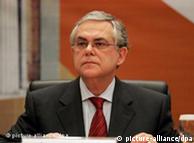
Greek Prime Minister Lucas PapademosPapademos's government has threatened a wage freeze if labor talks failJannis Varoufakis, economics professor at the University of Athens, is among the skeptics. He has been pleading for a long-term change of course and believes that Greece's European partners also carry responsibility.
"Not even God could get this austerity program to work," Varoufakis told Deutsche Welle. Not just Greece, but all the eurozone members are in danger of collapsing, because they have not closed ranks to tackle the crisis, he added.
No exit
And the blame game does not help either, Varoufakis said. Instead, a new conception is required for the euro and a program is needed that encourages growth, something like a pan-European investment program. 
Varoufakis said he strongly believes that reforms, although very necessary, cannot solve the debt crisis. If no concept is workable, then Greece should default within the eurozone. He warned of the collapse of the entire currency union.
"An exit from the eurozone would be economic suicide," Varoufakis said. "And in addition: In that scenario the euro would not survive 24 hours."
According to Varoufakis, the eurozone is constructed in such a way that a fatal domino effect could be triggered in a very short period of time. The consequences would be a deep recession in northern Europe, above all in Germany and the Netherlands, as well as an era of 'stagflation' among southern European debtor nations.
Author: Jannis Papadimitriou / slk
Editor: Sam Edmonds
 
 
dw

Greece under siege…

Theodoros Rousopoulos
About the Author
A riot police police officer baton charges a demonstrator during clashes in Athens.|EPA/ALKIS KONSTANTINIDIS
ATHENS - I have long been watching the international trial that my country is undergoing, and I am protesting. Everyone is laying siege to Greece – the story begins with Greek former prime minister George Papandreou who, in a crescendo of political foolishness, defamed my country abroad, to build on his image of being the ‘good guy’ and gain the grace and favour of European leaders for himself. What’s more, in an attempt to show how good a learner he was, he classified the Greeks as a nation of charlatans. At first, they slapped him on the back, congratulating him on his ‘bravery’ and then, as expected, they drove him into the corner. However, Greek pensioners and employees are set to be clobbered for many years to come. 
Nevertheless, there is something called ‘national dignity’. I cannot have any other country’s finance minister point the finger at me because he allegedly does me the favour of lending, when he has in fact been paid off during past decades, at very satisfactory rates of interest. In fact, interest rates are even higher now. I cannot allow, and neither have any previous leaders allowed, anyone who is a stranger to this country to humiliate Greece by discrediting it. With our words and deeds, we have given the country a chance to rank among the wealthiest countries in the world, to have much lower unemployment rates than those prevailing in other southern countries and to enjoy the right of having its voice heard on its own national issues. A pointed example is our refusal to have our neighbour, the former Yugoslavian Republic of Macedonia (FYROM) admitted to NATO, unless the issue of its name is resolved for good. 
I know that some of you may perhaps smile when reading about FYROM – maybe it’s because you have forgotten the last time that some of your own neighbours tried to steal and misappropriate a part of your own history. It is typical for us Greeks to always be reminded of the past – some lay additional blame on us, as they believe that in a world dominated by markets, cultural history is of no value. It is like enjoying the fruit of a tree and forgetting that its roots go deep down into the Earth….
Winston Churchill for Greeks 
We keep our past alive, but we do not live therein. Some might say that we do not honour our past. That we are not worth being the deserving descendants of prominent ancestors. I believe that such oversimplifications and generalisations are harmful, not only for Greece, but for humanity as a whole. Not all Greeks created miracles in the past, and its’ not just Greeks who are responsible for the current European mess. On the contrary, modern Greeks have decisively contributed to the formulation of a new Europe and to its rescue from totalitarianism. Am I going too far back in time? You, our dear German partners, also go back in time when you claim that you built the modern economic miracle in Europe – and you actually did. You forget, however, that you accomplished this with the solidarity of other people who suffered much at the hands of your ancestors. There are many Greeks living today, such as Manolis Glezos and Mikis Theodorakis, currently into the ninth decade of their lives, who stood up against Nazism and all kinds of fascism and still talk about World War II. They remind us of Winston Churchill’s phrase: “Hence, you will not say that Greeks fight like heroes but that heroes fight like Greeks.” One might ask when all is said and done, why I bother to recall all this and that besides, during the past 70 years, Alsace and Lorraine have heard gunfire only from hunters, not from war rifles, thank God. 
Greece, on the other hand, was hearing gunshots even during the 1990s from its neighbouring Balkans and even to this day from its neighbouring countries of North Africa. Do you remember the economic decay that my country suffered because of the Balkan War during the 1990s? Have you forgotten the millions of illegal immigrants who rushed into Greece, and were not removed to other Eurozone countries? I am not looking for excuses, I do not need them – I am only citing facts that are already known. 
Greece had the average debt and deficit levels of most European countries (see Eurostat announcement 22.04.10), although it represents only 2% of the European economy – a very low figure to have everyone laid siege to it. Of course, my country does not have the power to threaten foreign rating agencies with public prosecution, as was recently done by France and the US, when such agencies dared to downgrade their own banking systems. In the case of my country, foreign rating agencies simply said that it was a …technical mistake. 
Aphrodite de Milos as a ‘sex symbol’ for idiots!
Why all the fuss about Greece? Of course, I do not embrace the justification being spread by some of my countrymen that we are envied because we have the ‘best beach-front land in Europe with plenty of sun’. No. We have also made our own mistakes, we were the first to admit this and it would be unacceptable for us to claim that it is all someone else’s fault. However, there should be a measure for everything – the defamation of Greece is disproportionately huge, if compared with the actual problems that it is causing to Europe. Only idiots can smile at the gross propaganda of the press with the Parthenon sinking into a sea of debts and Aphrodite de Milos sodomising Greeks with her pointing finger. True Europe lovers are aggrieved at this kind of defamation, because they know that the Parthenon and Aphrodite shall modestly stand as magnificent monuments of culture for thousands of years to come. 
I am not enjoying my country being made to stand trial, no one would. To be accurate, in the Greek case, sentence was imposed before the hearing began. In this trial, those who are responsible and those who are not responsible, take the blame. The other day, I was informed by a friend that a Greek national who has been professionally active in Germany in transport business for 15 years has been subjected to ruthless financial control on his company premises and his family house, as if he were a common thief. Nothing blameworthy has come out of his business, as has been the case for 15 years. However, it was the first time that a control was carried out with the controllers’ suspiciousness overflowing. ‘He is Greek. Scrutinise him.’ ‘Kristallnacht’ began somewhat like this… 
I am implying nothing concerning the leaders of France and Germany. They are democrats who have fought, on a personal level, to climb their way up democratic systems. Their recent behavior, however, towards all other EU countries goes beyond the limit. They accuse my country of having breached the rules of the Eurozone but, at the same time, they themselves are breaching EU rules. Which treaty provides that France and Germany can jointly decide on the future of Europe and announce a new treaty to partners for their consent? Is such behavior not a breach of the fundamental principles of the European Union? 
Greece, armaments and ‘Merkozy’
They blame my country for its financial collapse, when the same leaders in all their meetings with Greek prime ministers, have been pushing my country to buy their own super-armaments, priced at many billions of euro. They muttered when they heard the Greek prime minister responding that the economy is not in a good enough situation to procure new armaments, but kept on pushing and pushing. We have now reached the point where Greece ranks between the top three countries of the world in the armaments market in proportion to its population – those leaders pretending to be ignorant and surprised by the drift of Greece’s economy and the same in Europe are therefore partners in crime. 
I understand that they are accountable to their own people. However, they have made a fundamental mistake – their populism has destroyed a Europe of solidarity and fostered ethnicism once more, which ruled during the mid-war and the Cold War periods. They have pushed Europe decades backwards. And something more – with their indecisiveness, backsliding and procrastination, they have allowed anonymous markets to determine the destiny of European people and pull the strings out of the stock-exchange markets and bank institutions. Today’s European leaders are not leading people; they are following markets and turning bankers into peer partners in decision-making. Instead of inspiring optimism in the hearts of European citizens and markets, they strike fear. Even Margaret Thatcher, a deeply anti-European leader, would be angered by such incompetence and lack of sound leadership in Europe – even she would become a ‘Europeanist’.